Hinduphobia Highlight: Educated Islamists and Terrorism
There is a trope used by leftists whitewashing Islamic terrorism, that terrorism is the result of poverty. This is patently untrue and not borne out by the data, in fact, Islamic terrorists tend to be more educated and richer than they populations they stem from. Upword has a great video linked below on “educated” Islamists and their terrorism campaigns in India over the last 45 years.
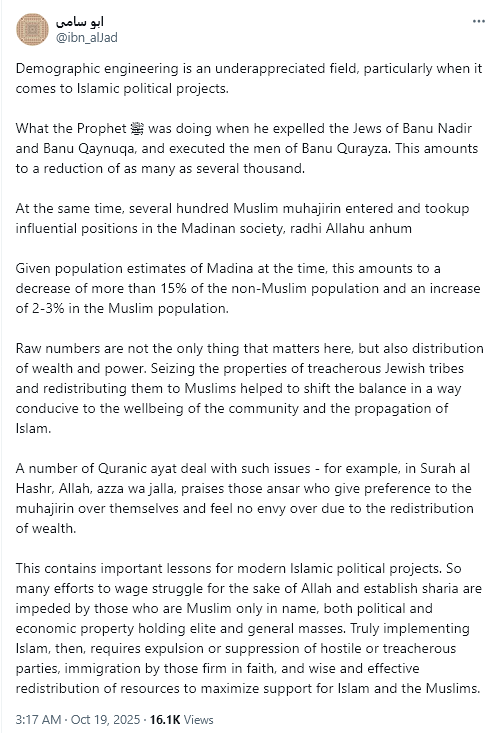
Religion Highlight: The Islamic Demographic Project
Now why is this topic interesting to Hindus? It explains a wide swathe of Indian history. Many parts of the Indian subcontinent were forested, especially East Bengal, in ancient times, and much of modern-day Bangladesh became majority Muslim through demographic engineering. Understanding the perspective of Muslim partisans allows us to clearly understand what we as Hindus need to do to not just preserve our land, but to refute folks who accuse Hindus of being aggressive.
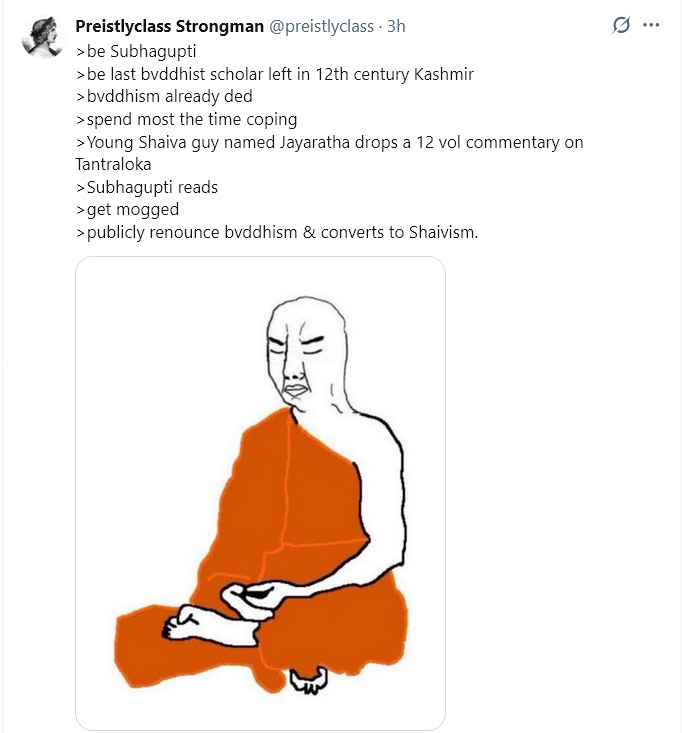
We have been loving the mini-biographies done by @preistlyclass on X/Twitter, go chuck him a follow for his humorous memes where you learn something about Hindu history!
You might ask why a Hinduism newsletter is highlighting an AI platform? Because we know that there are millions of untranslated documents in India and even more oral culture that needs to be transcribed. Removing language barriers between Hindus allows us to more clearly see what we share in practice, in the spirit of finding harmony between the registers of Hinduism. Additionally for the diaspora, it provides a way for 2nd generation and later to be able to learn and engage with their heritage language.
Welcome to Eternal Path! This week we highlight: Parallels between stories of the Nayanar saints and the Vedas, Winter Break Hinduism classes, and an aesthetic!
In Week 309, we had a feature on the idea of “Harmony between Registers of Hinduism”, linked here. Hinduism has its core in the Vedas, but the linkages between the many intellectual dimensions of Hinduism make it varied in practice and customizable in many ways. One of the authors who we had highlighted, Angirasasrestha, followed up between parallels between stories around the Nayanar Shaivite Saints of medieval Tamil Nadu (who we have highlighted in Week 2 and Week 272) and their Vedic equivalents.
“Memes you associate typically with Bhaktimārga have their Vaidika antecedents—Important to understand this so that one doesn’t develop a distorted view of the Śruti:
Sundaramūrti Nāyanār begging Śiva for forgiveness after breaking an oath
Vasiṣṭha begging Varuṇa for forgiveness for sins committed due to weaknesses/desires
Kaṇṇappa Nāyanār offering Ucchiṣṭānna to Śivaliṅga and water for abhiṣeka by spitting it from his mouth, with pure innocence.
Apālā offering Indra Soma juice by crushing the soma stalks with her teeth; Indra drinks it directly from her mouth
Appar/Tirunāvukkarasa Nāyanār undergoes torments at the hands of Śramaṇas for professing his faith in the Śaiva religion
Upagu Sauśravasa continues worshiping Indra despite being ordered by one Kutsa to not do so and ends up as a martyr, before Indra revives him
Nandanār/Tirunāḷaippōvār Nāyanār of the Pulaya kula gets exalted in the midst of Tillai-Dīkșitas. Tiruppāṇāḻvār is exalted by Viṣṇu who makes a priest honour him by carrying him.
Kavaṣa Ailuṣa is chased away into a desert by some Ṛṣis on account of his maternal lineage but the riverine Goddess Sarasvatī flows up to him and surrounds him on all sides, forcing the Ṛṣis to acknowledge him
Pūsalār Nāyanār builds a temple for Śiva in his heart, visualizing every detail of its structure in his mind, while a King is building an actual temple nearby. During the night prior to the consecration of the King’s temple, Bhagavān appears in the King’s dream to state that He will attend the consecration of His devotee’s temple first and that the King’s own temple will have to be consecrated later.
Both the Vāsiṣṭhas and one Pāśadyumna Vāyata are performing Somayāga at the same time but Indra prefers the former, with the hint in the Sūkta (ṚV 7.33) being that the Vāsiṣṭhas had intimate knowledge of the mantras and secret meanings.
Caṇḍeśvara-Nāyanār milks his father’s cows to bathe a Śivaliṅga, without being perturbed by his father’s anger, when the latter comes to kick the Liṅga
Ṛjraśva offers a hundred sheep belonging to his father to a she-wolf, which he immediately recognises as being sent by the Aśvinau (the divine twins))”
As one can see from this short list, it is clear that there are linkages between the different registers of Hinduism, and that bhakti is not something separate from the Vedas, it is a path toward upholding Vedic knowledge.
Learning Highlight: Winter Break Classes
Our friends at Hindu Parents Network are running two Winter Break sessions on Hinduism learning that we highly encourage parents and temples to sign up for, details below.
Dec 22–26 | 11 AM – 1 PM EST | 5 Sessions (10 Hours) | $100 | Ages 8-15
A powerful, story-based journey that helps children build strong character, clarity, and confidence — rooted in Hindu values cherished across the world.
Welcome to Eternal Path! This week we feature: the world’s oldest Sanskrit manuscript, a piece on allegations of Hindu nationalism towards diaspora students, the and an aesthetic!
History Highlight: The Oldest Surviving Sanskrit Manuscript
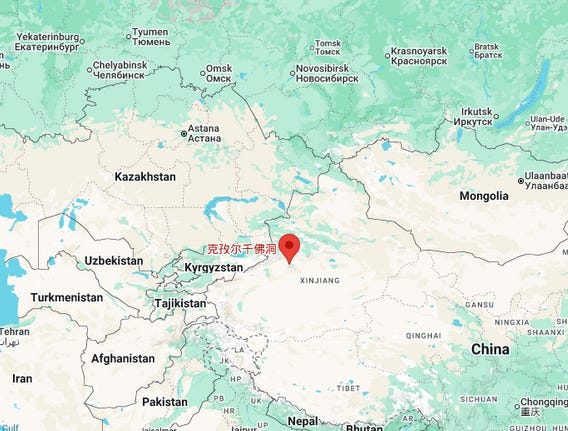
When you hear the phrase “Oldest Surviving Sanskrit Manuscript", where do you think it was found? Varanasi? Delhi? Maybe somewhere in modern-day Pakistan? Nope. The oldest surviving Sanskrit manuscript was actually found in modern-day China, in the Kizil Caves, in modern-day Xinjiang province!
Kizil Caves on Google Maps. Note how far it is even from Kashmir.
The Kizil Caves are a Buddhist monument and a system of rock-caves built near a trading center on the Silk Road. Near them, German archaeologists found shards of a document later known as the Spitzer Manuscript in 1907 while on a quest to explore the Buddhist history of the Silk Road. The German expedition discovered the caves, and more relevant to us, 2,000+ palm-leaf fragments of Sanskrit writings stored together. The first person to analyze these manuscripts was a German-Jewish Indologist named Moritz Spitzer, after whom the manuscript was named.
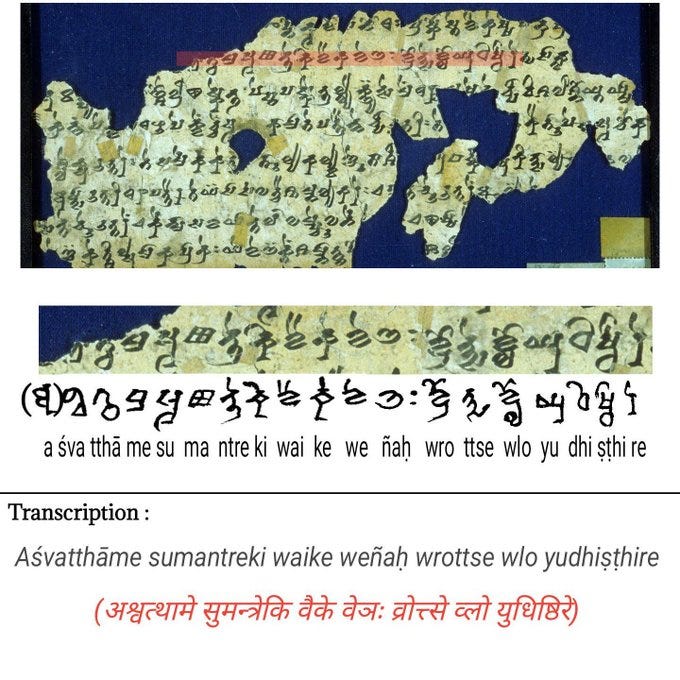
The manuscripts were written in a variation of the Brahmi script (the forerunner to most modern Indian scripts) known as the Kushana-Brahmi script. Most of the fragments were Buddhist in nature, but about 30% were relating to Hinduism, including a lot of text on the Vaisheshikha philosophical school of thought. Fragments from the Mahabharata also feature prominently amongst the fragments, including this example below, written in a Sanskritized dialect of Tocharian (an extinct Indo-European language from an extinct subfamily spoken in the Tarim Basin of modern-day China)
This verse concerns the episode in the Mahabharata where Yudhistira attempts to deceive Bhishma about the death of his son Ashwathama. Manasataramgini has an analysis of the script linked here that we highly recommend reading as well. He mentions most interestingly that the Buddhists probably had the material on Hindu philosophy and the Mahabharata to try and assert their nastika religion on astika terms.
Reading Highlight: My name is Aryan and I am not a Hindu Nationalist
Aryan is a young Hindu leader with a poignant piece about how all expression of Hinduism and Hindu interests on college campuses and elsewhere gets tarred with allegations of “Hindu nationalism”, even in second-gen and later contexts. It is important for our readers to speak up against people using political jibes to shut down expression of Hindu practices or advocacy for Hindu causes. Chuck him a follow!
Religion Highlight: Harmony between Registers in Hinduism
Adapted from posts from @Ghorangirasa (Angirasasreshtha) and @blog_supplement (Manasataramgini) The original posts are linked in their @s.
Hinduism contains multitudes; whether its the 33 types of deities, the different sects of Hinduism, the different languages used by Hindus in their daily lives, the different ethnic and racial groups worshipping the Gods, and lastly, the levels by which Hindus perceive and practice the religion. Some perceive Hinduism at the level of a Philosophical exploration and some perceive it as simple bhakti (devotion), fueled purely by belief and tradition. How does one bridge high-level philosophy and texts with the Hinduism on the ground?
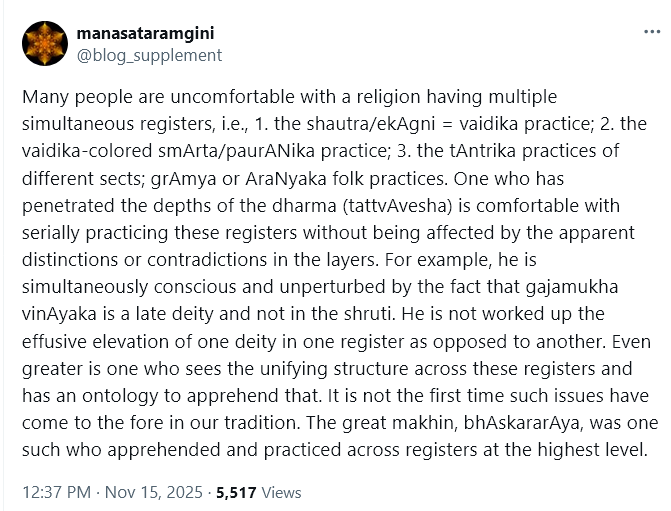
Manasataramgini (MT) below outlines how Hinduism has multiple “registers” of practice, with our analysis below the screenshot.
Manasataramgini on the “Registers” of Hinduism
Category 1 is the Hinduism of the Vedas, Category 2 is Hinduism of the Vedas and a broader universe of texts (puranas, upanishads, etc) and Category 3 is Folk Hinduism. Most popular practice of “Hinduism” bridges categories 2 and 3. MT then defines someone that actually understands concepts across these registers as a tattvAvesha (Sanskrit for “one with a deep understanding of reality” - from tattva meaning “reality/truth” and avesha meaning “entering/infusion”).
So what is the takeaway here? The tattvAvesha, when they encounter a tradition in the Hindu universe, rather than acting in a sectarian way, or in criticizing it through a secularist lens will ask first “What else does this resemble in the broader Hindu tradition?” This is how Hindus gain an appreciation for all the intellectual layers of Hindu tradition, and how Hindus (especially in the diaspora) can bond with other Hindus, by participating in each other’s traditions by understanding how they relate to each other and to the timeless knowledge in the Vedas.
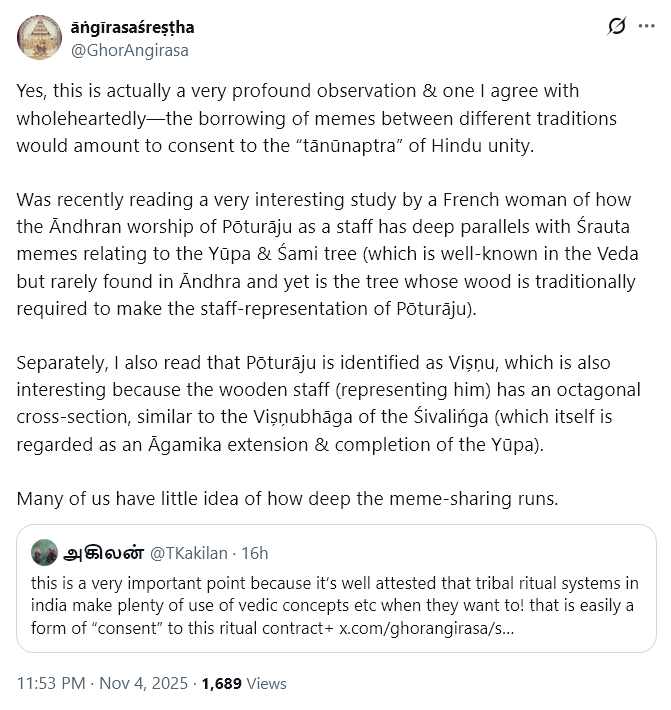
In an unrelated thread, Angirasashrestha below inadvertently resembles himself to be a tattvAvesha. He identifies a tradition from rural Andhra Pradesh (Category 3 - folk ritual) and links to a pure Vedic concept (Category 1 - Vedic ritual) and then later links to the Saiva agamas (Category 2, non-Vedic Sanskritic ritual).
Many will make an argument that tribal traditions are non-Hindu, and Hindus are often put on the backfoot because a tribal tradition may not be mentioned in the Vedas or other Sanskritic texts. However, Angirasashrestha through his example, and Manasataramgini through his framework, provide a blueprint for Hindus to assert the continuity of their tradition across intellectual registers. May we all become tattvAvesha and continue to build a stronger Hindu community.
Hinduphobia Highlight: Religious Nationalism Tour
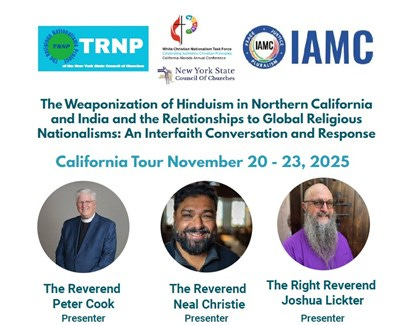
In a country where Islamic terrorism and White Nationalism are two of the most dangerous and deadly ideologies, and one with a Northern neighbor where Khalistani terrorism is a deadly ideology comes the “Bay Area Religious Nationalism Tour”, a collaboration between: The New York State Council of Churches, the Indian American Muslim Council, and the White Christian Nationalisms Task Force focused on the “Weaponization of Hinduism in Northern California”.
This sort of insidious Hinduphobic handshake between leftist wokes and Islamist and Christian bigots is part of a movement to salt the earth against any expression of Hinduism. This tour also stops at a Sikh temple known for Khalistani sympathizers. Groups associated with these clowns have claimed things like Bal Vihar classes and parades featuring temples are dangerous religious nationalism. This puts a target on the back of the Hindu community.
Unsurprisingly the fraud group “Hindus for Human Rights” (HfHR) has not condemned this Hinduphobic tour. It is incumbent for Hindus to call these people out consistently as the bigots they are. Make sure that people know these folks are bigots, and that so-called “Hindus” like those in HfHR do not represent the Hindu community.